
During a sitting of the Public Investments Committee on Social Services, Administration and Agriculture, chaired by Vice-chairperson Caleb Amisi last week, KMTC CEO Dr Kelly Oluoch and his senior management team faced tough questioning over recurrent debt problems, the massive pension shortfall, governance lapses and delayed institutional reforms
To unlock the full article:
Choose one of the options below:
- Ksh 10 – This article only
- Ksh 300 – Monthly subscription
- Ksh 2340 – Yearly subscription (10% off)
By The Weekly Vision Reporter
Members of the National Assembly have put the Kenya Medical Training College (KMTC) under intense scrutiny over a staggering KSh 2.125 billion pension deficit and long-standing financial disputes dating back more than 20 years.
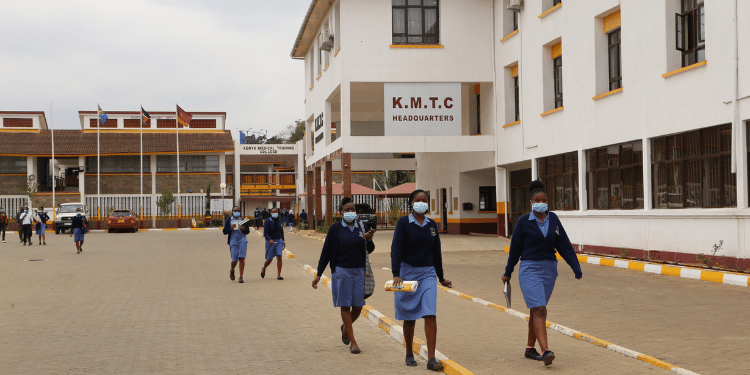
During a sitting of the Public Investments Committee on Social Services, Administration and Agriculture, chaired by Vice-chairperson Caleb Amisi last week, KMTC CEO Dr Kelly Oluoch and his senior management team faced tough questioning over recurrent debt problems, the massive pension shortfall, governance lapses and delayed institutional reforms.
Committee members expressed frustration at what they described as “routine” issues that have persisted for years.“These issues are routine, and we must conclude them once and for all,” Mr Amisi declared. The committee resolved to summon several government institutions, including Kenyatta National Hospital, the University of Nairobi, the Attorney-General’s Office, the Ministry of Health, the Ministry of Education, the Ministry of Lands and the National Land Commission, to expedite a final resolution. A major point of contention was KSh 7.4 million in rent arrears owed by the University of Nairobi for 96 rooms occupied by medical students.
Despite an eviction notice issued in July 2018, the university has neither responded nor vacated the premises. KMTC informed the committee that the matter had been escalated to the Attorney-General and the Head of Public Service, with documentation confirming that the property legally belongs to the college.KMTC also sought Treasury guidance on writing off long-outstanding debts, including KSh 21.8 million owed by Kenyatta National Hospital and KSh 19.8 million owed by the former Ministry of Medical Services.
Both amounts had been recommended for write-off but were still awaiting ministerial approval. The most alarming revelation was the KSh 2.125 billion pension deficit in the college’s defined-benefit scheme as of June 2024. Dr Oluoch explained that actuarial valuations showed scheme assets had not grown sufficiently to meet obligations to current and future retirees.“While pension benefits for current retirees are protected by law, we have had to finance remedial measures from student fees,” he said, warning that continued reliance on student revenue could trigger serious long-term liquidity challenges without Treasury intervention.
KMTC has since increased the employer contribution rate from 20 per cent to 27.6 per cent, with effect from July 2024, and committed to injecting KSh 100 million annually into the scheme. The committee resolved to invite the Retirement Benefits Authority and the National Treasury to examine systemic problems affecting pension schemes in public institutions. On governance, KMTC admitted that only 16 campuses, four hospital maintenance schools and one school of clinical medicine have been formally gazetted, despite operating dozens of campuses nationwide. Management assured members that no student was disadvantaged and pledged to fast-track the gazettement process.
The Auditor-General also flagged the college for exceeding the statutory limit of six board meetings per year. Although the extra meetings were justified by statutory functions and graduation preparations, the committee insisted the breach must still be rectified. Another concern was that a number of KMTC staff were receiving less than the legally required one-third of their basic salary as take-home pay because of heavy statutory deductions, including the Housing Levy, SHIF and NSSF contributions.
Management explained that many employees had taken loans before the new deductions were introduced, making compliance difficult. The committee questioned the practicality of expecting staff to restructure loans amid current economic pressures.KMTC was also found to be below the mandatory 5 per cent employment quota for persons with disabilities, with only 52 of its 2,131 employees (2.4 per cent) falling into this category.
The college promised to work with the NG-CDF offices to improve recruitment in this area. Despite revenue under-collection of KSh 102 million and under-expenditure of KSh 993 million in the 2023/2024 financial year, KMTC assured the committee that service delivery had not been compromised. Mr Amisi acknowledged the institution’s critical role in Kenya’s medical tourism ambitions.
“If we strengthen institutions like this one, they can place us in good standing to become a medical tourism destination,” he said, pledging continued parliamentary support in reviewing legal frameworks and resolving historical audit queries.
[/full]