By The Weekly Vision Team
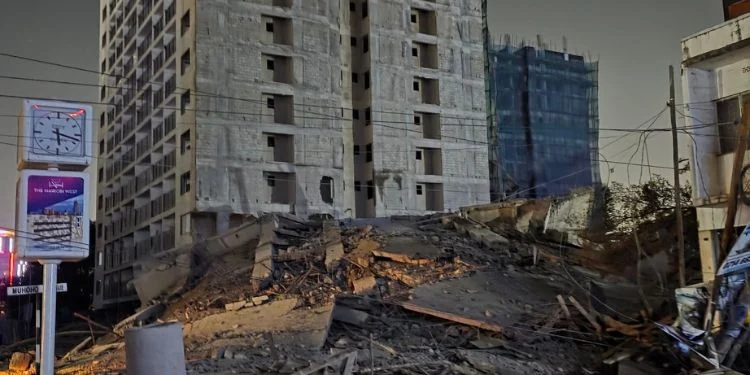
A multi-storey building under construction in Nairobi’s South C estate collapsed in a catastrophic “pancake” failure in the early hours of 2 January 2026, killing at least four people, two of whom are believed to have been night security guards. The incident has raised profound questions about regulatory failure, corruption, and enforcement impunity in Kenya’s booming construction sector.
The structure, located along Muhoho Avenue near South C Shopping Centre and Nairobi South Hospital, was reportedly between 14 and 16 storeys high when it caved in at around 4:05 a.m., producing a massive dust cloud captured on viral CCTV footage. Multi-agency rescue operations, led by the Kenya Red Cross, the National Disaster Management Unit, the Kenya Defence Forces Disaster Response Battalion, the National Youth Service, and the Nairobi Fire Brigade, continued into a second day. Sniffer dogs were deployed as hopes of finding survivors faded.
Public Service Cabinet Secretary Geoffrey Ruku, briefing at the site, confirmed that the building had been approved for only 12 floors but had been illegally extended beyond that limit, leading to suspected column overload. A stop order had been issued by Nairobi City County in August 2025, yet construction continued.
County officials revealed that the project had been flagged for violations at least three times in 2025, in May, July, and December, for exceeding approved plans. The National Construction Authority (NCA) confirmed that the building was non-compliant and named the developer as Abyan Consulting Limited, linked to Yussuf Mohammed Yussuf. Professionals involved included architect Gideon Chege Mwangi, engineer Peter Kimani Kireru, and quantity surveyor James Kirika Njoroge. The developer’s practising licence had expired in July 2024.
An adjacent high-rise has been declared high-risk due to structural compromise caused by the collapse, prompting continued monitoring and expanded safety cordons. President William Ruto directed an immediate multi-agency response, while MPs, including Lang’ata’s Phelix ‘Jalang’o’ Odiwuor and Embakasi East’s Babu Owino, called for the suspension of all construction in South C and Nairobi West pending comprehensive audits, alongside independent investigations into alleged bribery and oversight failures.
The tragedy underscores Nairobi’s chronic building safety crisis. Rapid urbanisation has fuelled demand, but greed and weak enforcement continue to allow rogue developers to flout regulations. A 2015 audit found that 58 per cent of city buildings were unfit, an assessment that appears little changed today.
As investigations proceed and promises of accountability are made, the nation waits to see whether this collapse will finally trigger meaningful reform or simply join Kenya’s long list of unheeded warnings.
[/full]