By The Weekly Vision Reporter
For over a year, President William Ruto has maintained a deafening silence about his role in the October 2024 impeachment of former Deputy President Rigathi Gachagua. Aside from his repeated praise of his current deputy, Prof Kithure Kindiki, as the ideal second-in-command, while discrediting Gachagua’s leadership credentials, the President has largely refrained from revealing his involvement in the latter’s unceremonious removal via a motion sponsored by Kibwezi West MP Mwengi Mutuse.
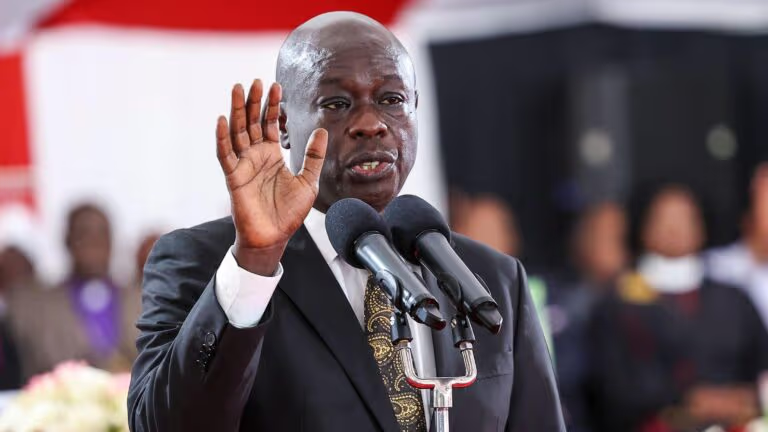
However, during an emotional outburst during a development tour of Bungoma County on Tuesday, President Ruto inadvertently appeared to reveal his hand in the impeachment. He reiterated a key argument that the anti-Gachagua camp had heavily relied upon to support their case for the then Deputy President’s removal.
Addressing crowds at various stopovers, the President revisited claims initially raised by James Orengo, who represented the National Assembly during the impeachment proceedings, about Gachagua’s alleged attempt to influence his elder brother, former Nyeri Governor Nderitu Gachagua’s will.
A visibly agitated Ruto, without directly naming Gachagua, recounted how an individual allegedly visited his late brother’s deathbed at a London hospital and attempted to persuade him to alter his will in his favour, to the detriment of his immediate family. “Mtu mwenye yuko na pepo ya chuki na ukabila, anatuambia nini jameni? Mtu ambaye anaenda kwa kitanda cha nduguye anayekufa, eti a manipulate will ili anyakue mali yake, to disenfranchise wajane na mayatima, anatuambia nini jameni?”
“A person driven by hatred and tribalism, what can such a person tell us? Someone who goes to a dying brother’s bedside to manipulate a will and disenfranchise widows and orphans, what can such a person tell us?” the President posed.
The remarks appeared to expose a narrative that critics argue was carefully choreographed by forces keen on pushing Gachagua out, potentially reaching the highest levels of government.
The involvement of both Orengo and Rarieda MP Otiende Amollo as counsel for the National Assembly did little to conceal the widening political rapprochement between President Ruto and the late Raila Odinga, the then leader of the Orange Democratic Movement (ODM).
Orengo’s participation in the proceedings was strongly opposed by Gachagua’s defence team, led by senior counsel Paul Muite, who argued that, by virtue of serving as a governor, he was not qualified to represent the National Assembly in the matter.
The speed with which Gachagua was removed from office, within hours of the conclusion of the impeachment proceedings, further raised eyebrows. A series of gazette notices was issued in rapid succession: one appointing Prime Cabinet Secretary Musalia Mudavadi as acting Interior Cabinet Secretary in place of Prof Kindiki; another declaring a vacancy in the Office of the Deputy President; and a third proclaiming a public holiday to facilitate Kindiki’s swearing-in.
Highly placed sources would later reveal that Gachagua’s removal had long been in the works, preceded by a series of high-level meetings, some reportedly held at State House, to deliberate on the matter.
According to sources who requested anonymity due to the sensitivity of their positions, President Ruto had initially been reluctant to support efforts to oust his deputy. The push was largely driven by MPs and senior government officials from Gachagua’s Mt Kenya political base, many of whom cited intimidation.
In one such meeting at State House, the President was reportedly shown lengthy text messages allegedly sent by Gachagua to several MPs, accusing them of various offences, including insubordination and disrespect for the Office of the Deputy President. Sources further claim that President Ruto produced his own phone and shared messages he had personally received from Gachagua, reinforcing lawmakers’ concerns.
It also did not go unnoticed that last-minute meetings to consolidate support for the impeachment motion were reportedly held at the Weston Hotel, a facility associated with the First Family.
President Ruto’s remarks in Bungoma now appear to confirm, at least in part, his active role in the chain of events that culminated in Gachagua’s dramatic fall from power