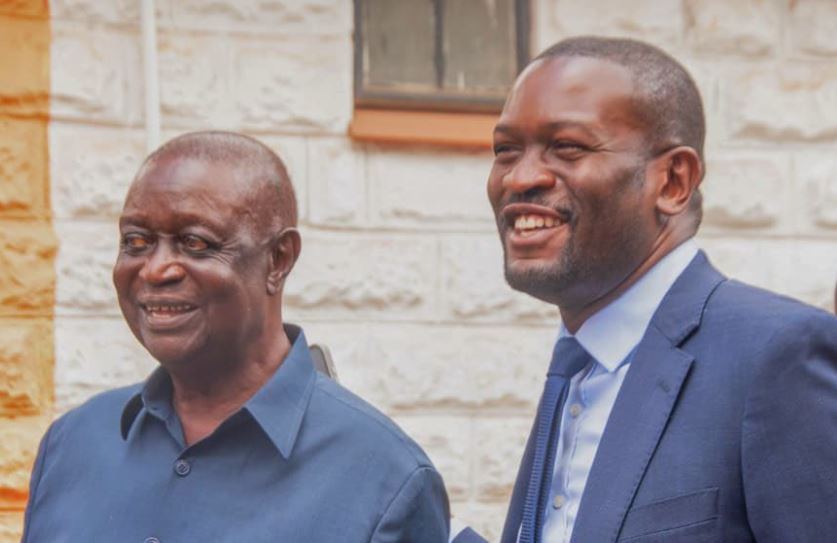
What was once hailed as a bold handshake to steady the nation now appears to be unravelling. The uneasy pact between William Ruto’s UDA and the late Raila Odinga’s ODM is increasingly strained, raising fresh doubts over its durability and the country’s broader political path as Kenya inches towards the 2027 General Election
To unlock the full article:
Choose one of the options below:
- Ksh 10 – This article only
- Ksh 50 – Access to ALL articles on the site (full site access)
- Ksh 300 – Monthly subscription
- Ksh 2340 – Yearly subscription (10% off)
By The Weekly Vision Political Desk
The political pact between President William Ruto’s United Democratic Alliance (UDA) and the Orange Democratic Movement (ODM), once seen as a stabilising force, is now showing clear signs of strain. The growing fractures are fuelling fresh uncertainty over the country’s political direction as the 2027 General Election draws nearer.
The broad-based arrangement, formalised on 7 March 2025 at the Kenyatta International Convention Centre, was signed by President Ruto and the late opposition leader Raila Odinga. Anchored in a ten-point Memorandum of Understanding (MoU), the pact was presented as a bold attempt to foster national unity following years of political rivalry, post-election tensions, and the June 2024 protests. Its agenda included economic reforms, anti-corruption measures, strengthening devolution, and expanding social safety nets.
However, less than a year after Raila’s death in October 2025, the arrangement appears increasingly fragile. Last Friday, ODM’s Central Management Committee (CMC) suspended discussions on a possible pre-election coalition with UDA for 2027. The party cited concerns over alleged coercion of its Members of Parliament, lack of mutual respect, and slow progress in implementing key elements of the MoU. The move has intensified speculation that ODM could be preparing to disengage from the arrangement altogether.
From its inception, the pact was never intended to be a full coalition government. ODM remained formally outside the executive, although several of its senior figures took up key government roles, including Energy and Petroleum Cabinet Secretary Opiyo Wandayi, Treasury Cabinet Secretary John Mbadi, Mining Cabinet Secretary Ali Hassan Joho, and Co-operatives Cabinet Secretary Wycliffe Oparanya.
Crucially, the agreement carried a sunset clause, expiring on 7 March 2026. Some of Raila’s closest allies, including his brother Oburu Oginga, now serving as interim party leader, still maintain that the arrangement would be reviewed based on performance. As recently as December 2025, Oburu reiterated that ODM’s participation would depend on tangible delivery of the agreed agenda, signalling that the party’s commitment was conditional rather than permanent.
Dissatisfaction within ODM appears to have reached a tipping point. During a charged CMC meeting held on 16 April in Nairobi, senior party figures raised a series of grievances that have been building for months. Among the key concerns were allegations that state actors are exerting pressure on ODM legislators, particularly in the Coast and Western regions, to defect to UDA. Party officials also expressed frustration over what they view as inadequate consultation and respect within the arrangement.
Former Secretary-General Edwin Sifuna has been particularly vocal, warning that ODM retains “options” and will not allow itself to be sidelined. The decision to suspend coalition talks was widely interpreted as a strategic signal that the party is reassessing its engagement with the Ruto administration.
One of the dominant narratives emerging from political circles centres on the 2027 succession equation. Speculation has been rife that ODM could seek the deputy presidency as a condition for continued cooperation.
Before his death, Raila Odinga had kept his options open, at one point suggesting that ODM might field its own presidential candidate. That ambiguity has emboldened factions within the party that favour reclaiming an independent political path rather than supporting President Ruto’s re-election bid.
Figures such as Edwin Sifuna and Siaya Governor James Orengo are seen as sympathetic to this position, arguing that unconditional alignment with UDA risks eroding ODM’s identity and political base. However, senior party insiders have downplayed claims that ODM has formally demanded the running-mate position. Instead, they indicate that the party is focused on strengthening its grassroots structures before making any definitive decisions about 2027.
For President Ruto, the running-mate question presents its own complications. Deputy President Kithure Kindiki, who replaced Rigathi Gachagua following his impeachment in October 2024, is seen as central to maintaining support in the Mount Kenya region. Any move to replace him with an ODM figure could risk alienating a key voting bloc and reopening regional tensions.
Compounding the political tensions is the unfolding crisis in the petroleum sector, which has further strained relations within the arrangement. A series of high-profile resignations and arrests in early April, including Petroleum Principal Secretary Mohamed Liban, Kenya Pipeline Company Managing Director Joe Sang, Energy and Petroleum Regulatory Authority Director-General Daniel Kiptoo Bargoria, and Deputy Petroleum Director Joseph Wafula, has triggered a major scandal.
The controversy centres on allegations of manipulated stock data, irregular fuel imports, and concerns over product quality. The fallout has coincided with rising fuel prices, intensifying public frustration amid an already high cost of living. ODM has publicly expressed “profound outrage” and called for swift and transparent investigations. However, the crisis has placed the party in a delicate position, given that the Energy and Petroleum docket is under one of its own senior figures.
Privately, some ODM leaders have expressed concern that the government’s handling of the scandal risks portraying the party as complicit, undermining its reformist credentials.
While the 2027 political equation and the petroleum scandal have dominated public discourse, analysts suggest that the deeper issue lies within ODM itself. The party is navigating a complex post-Raila transition marked by internal succession dynamics, generational shifts, and the challenge of maintaining relevance without its long-time leader. While Oburu Oginga has provided interim stability, emerging voices within the party are increasingly assertive in shaping its future direction.
At the same time, President Ruto faces competing pressures within UDA, including managing internal dissent and maintaining regional alliances ahead of 2027.
The potential fallout from a breakdown in the ODM–UDA arrangement carries significant political implications. For the Ruto administration, it could reopen ethnic and regional divisions that the pact sought to bridge. For ODM, exiting the arrangement could reinvigorate its base but also expose it to criticism for abandoning a unity initiative.
With public discontent rising over economic pressures, neither side is guaranteed a political advantage should the partnership collapse. As Kenya edges closer to the next election cycle, the future of the Ruto–ODM pact remains uncertain. Whether the current tensions lead to a formal rupture or a recalibrated partnership will depend on political calculations in the weeks and months ahead.
What is clear, however, is that an alliance once framed as a cornerstone of national stability is now under severe test, its survival hanging in the balance as the country’s political landscape begins to shift once again.
[/full]