According to reliable sources within the Nairobi airport, it will take concerted efforts to stem the use of JKIA as a distribution node by drug barons, as they have established an elaborate network of facilitators embedded in the airport infrastructure in critical areas such as security and cargo handling, among others, to traffic drugs
To unlock the full article:
Choose one of the options below:
- Ksh 10 – This article only
- Ksh 50 – Access to ALL articles on the site (full site access)
- Ksh 300 – Monthly subscription
- Ksh 2340 – Yearly subscription (10% off)
By The Weekly Vision Investigations Team
Despite intensified screening operations by the Directorate of Criminal Investigations’ (DCI) Anti-Narcotics Unit at Jomo Kenyatta International Airport (JKIA), which have recently led to several arrests, the airport continues to be regarded as a major transit gateway for narcotics destined for European markets.
According to reliable sources within the Nairobi airport, it will take concerted efforts to stem the use of JKIA as a distribution node by drug barons, as they have established an elaborate network of facilitators embedded in the airport infrastructure in critical areas such as security and cargo handling, among others, to traffic drugs.
While the use of human mules has long been the main method of moving drugs to their destinations, enhanced surveillance, especially at airports in Europe and Asia, has resulted in numerous arrests and prosecutions in recent years, and has seen drug traffickers increasingly shift to the parcel system.
The traffickers conceal the narcotics within various legitimate cargo items such as clothes, food, shoes, wigs, bath products and personal electronics to camouflage them. Others use everyday, innocent-looking items like soda cans, lipstick tubes or highlighter pens, which are hollowed out to hold drugs.
They are then sent abroad as parcels through reputable courier firms, either without their knowledge or through collusion between the criminals and rogue staff. At the airport, they are delivered to the courier firms’ cargo sheds in the cargo area, from where they are delivered directly to the airlines by staff with security clearance. Across the chain, the traffickers exploit vulnerabilities among staff working at the airport, such as baggage handlers, low-cadre security personnel and airline crew, to facilitate the trade.
Last year’s jailing of Kenya Airways cabin crew members Lennox Chengek Chestit and Alfric Odhiambo Otieno, alongside ground staffer Kenneth Sinzore Isundu, to 25 years in prison for smuggling heroin valued at more than KSh 60 million, gives a pointer to how elaborate the network is. However, according to our sources, those often caught are the small fish, which makes it difficult to tackle the syndicate as the traffickers have facilitators in higher ranks who recruit fresh mules to replace those arrested or sacked. “The government, especially the DCI, is doing a good job in collaboration with global partners but until they fish out the key enablers sitting in critical positions, they have a long way to go,” one source, who works for a cargo handling company at JKIA, told The Weekly Vision on condition of anonymity.
“The collusion mostly happens between the traffickers and staff in couriers, security, cargo and airlines. Once the parcel is delivered in the cargo area, they lie in wait for the flight time to approach before it is delivered to the flight if it remains undetected. It is an almost seamless process that avoids many risks.”
He revealed that the syndicate takes advantage of the huge amount of cargo JKIA handles on a daily basis, as speedier processing times often reduce thorough inspections. According to estimates, JKIA processes between 990 and 1,020 tonnes of cargo daily, driven heavily by horticultural exports like flowers and vegetables. Indeed, in 2021/2022, it was ranked the busiest airport in Africa for cargo, surpassing Cairo and Johannesburg.
However, there are instances where drugs have been discovered during verification by Kenya Revenue Authority (KRA) customs staff. In July last year, KRA staff intercepted a male passenger arriving from Bangkok with 41 sachets of suspected narcotics hidden in his two suitcases. In February, for instance, amphetamines were discovered in a shipment destined for Australia from Bujumbura, Burundi, which had been concealed in 10 large candles packed in a carton.
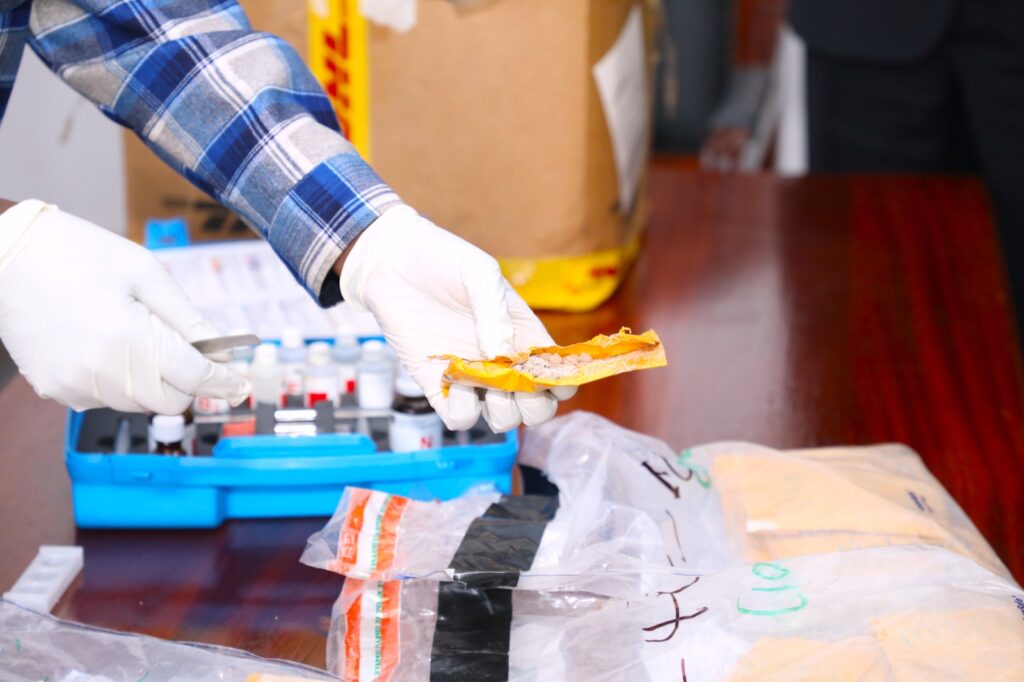
The discovery was made at the DHL cargo shed, where tests on the whitish crystalline substance found stashed in the carton and wrapped using yellow cellotape tested positive for the highly addictive drug. In 2020, KRA customs officers also intercepted a consignment of heroin that was en transit from Juba, South Sudan, to Cambodia.
The drugs were concealed in the buttons of dresses but were detected by non-intrusive scanners. There have also been multiple other seizures, including bhang, cannabis oil vape cartridges and hashish, often concealed in various items like vitamin tablets, postal mail packages and clothing. According to a United Nations Office on Drugs and Crime (UNODC) report presented to the 32nd Meeting of Heads of National Drug Law Enforcement Agencies, Africa, in Vienna, Austria, in October last year, there was a notable spike in 2024 in seizures of methamphetamine, tramadol, ketamine and other controlled substances. Furthermore, in April 2024, 6.4 kilogrammes of crystal methamphetamine sent from Uganda were seized en route to Indonesia, and several seizures in November 2024 involved packages bound for the Philippines and New Zealand.
“These cases point to the expanding role of Kenya as a repackaging and export hub for the West and Southern African markets, which use air cargo, fast parcels and postal networks,” the report said.
[/full]