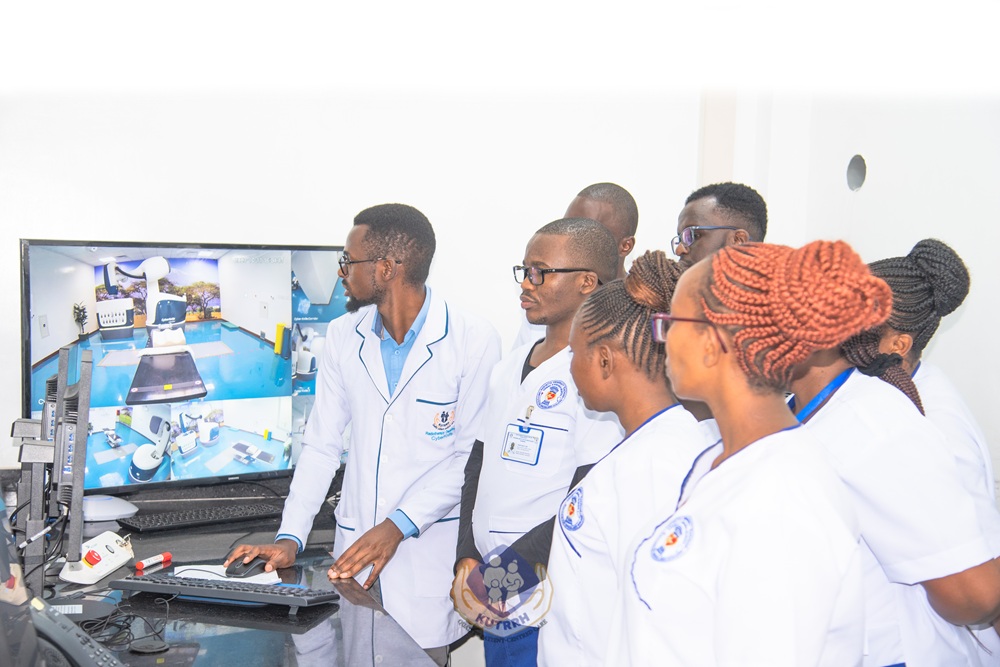
More than 300 students from medicine, public health, medical services and other allied health programmes reported to the national referral hospital this week for induction, following the signing of a cooperation agreement between KU and KUTRRH late last year
By The Weekly Vision Reporter
After years of uncertainty that disrupted academic progress and sparked repeated protests, Kenyatta University (KU) medical students have formally commenced clinical training at the Kenyatta University Teaching, Referral and Research Hospital (KUTRRH), marking a decisive turning point in Kenya’s medical education landscape.
More than 300 students from medicine, public health, medical services and other allied health programmes reported to the national referral hospital this week for induction, following the signing of a cooperation agreement between KU and KUTRRH late last year. The agreement resolved prolonged disputes that had previously locked students out of the facility.
The development is widely viewed as the end of one of the most protracted standoffs between a public university and a teaching hospital in recent years, a conflict that had delayed clinical exposure for successive cohorts of students.
During the induction, KUTRRH Chief Executive Officer Dr Zainab Gura welcomed the students, describing the collaboration as the foundation of a long-term academic partnership focused on practical training, research and innovation.
She said the hospital would provide a specialised learning environment designed to equip students with hands-on skills and professional competence, while noting that the partnership would gradually be expanded to support additional academic programmes.
Kenyatta University Vice-Chancellor Prof. Paul Wainaina, who accompanied the students, acknowledged the difficulties that had preceded the agreement. He said the commencement of clinical rotations represented a significant milestone for both the institution and its learners.
According to Prof. Wainaina, access to a fully fledged referral hospital restores the integrity of KU’s medical training and ensures students receive the clinical exposure required to prepare them for professional practice. He urged both institutions to protect the partnership to safeguard the future of medical education.
For the students, the start of training carried deep symbolic meaning. Many described the moment as the end of years marked by stalled progression, uncertainty and anxiety over delayed graduation.
Medical students said KUTRRH’s advanced facilities, specialised units and exposure to complex cases would help bridge the long-standing gap between classroom learning and real-world medical practice.
Several students also pointed to the hospital’s research infrastructure as a major advantage, noting that access to modern equipment and innovation hubs would enhance their academic and professional development.
Health education experts have welcomed the partnership, saying it comes at a critical time when Kenya is facing a shortage of specialised healthcare professionals amid growing demand for quality health services.
By integrating medical students into one of the country’s most advanced referral hospitals, the collaboration is expected to strengthen the future healthcare workforce while enhancing patient care through teaching and research.
As clinical rotations get underway, both KU and KUTRRH say attention will now shift to implementation, coordination and mentorship to ensure students gain maximum benefit from the long-awaited partnership.