By The Weekly Vision Reporter
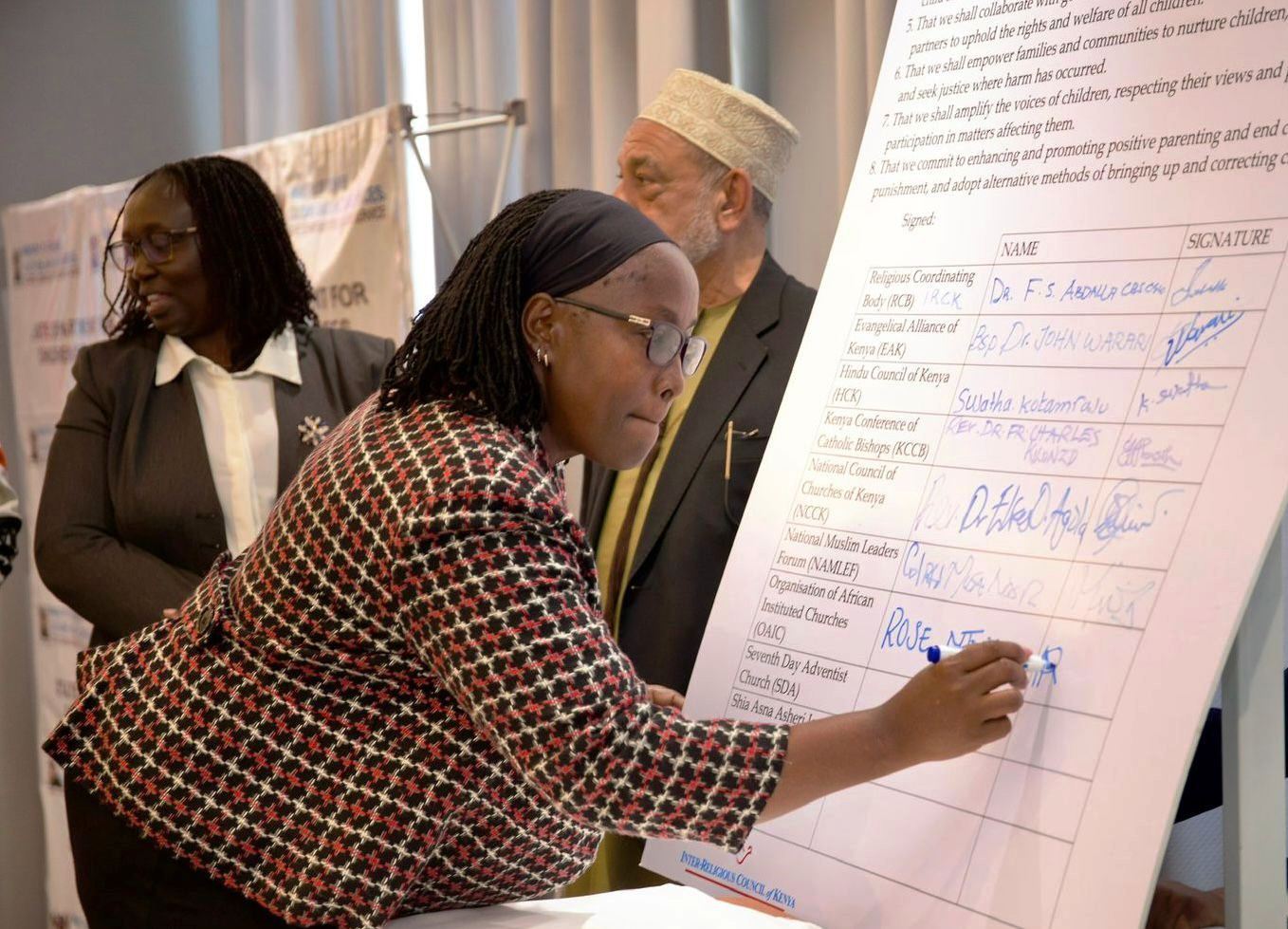
A major step forward in strengthening national child protection efforts was achieved on Wednesday, 4 February 2026, when senior religious leaders from across all major faiths in Kenya signed the National Religious Leaders’ Declaration on Child Safeguarding.
This historic act marks a bold, united commitment to protect children from violence, abuse, and harmful practices. The declaration was endorsed during the inaugural National Religious Leaders’ Summit on Child Safeguarding, convened by the Ministry of Gender, Culture and Children Services in collaboration with the Inter-Religious Council of Kenya (IRCK) and UNICEF.
The initiative forms part of the UNFPA-UNICEF Joint Programme on the Elimination of Female Genital Mutilation in Kenya. The signing ceremony was complemented by the launch of “Faith for Life: Protecting and Safeguarding Our Children”, a new faith-based safeguarding handbook.
This practical resource equips religious institutions with tools to develop child-friendly policies, promote safe practices, and encourage positive parenting. Together, the declaration and handbook represent a decisive shift towards coordinated, values-driven leadership in child protection nationwide.
Speaking at the summit, Cabinet Secretary for Gender, Culture and Children Services, Hanna Wendot Cheptumo, said: “The Government of Kenya, led by the State Department of Children Services through the Ministry of Gender, Culture and Children Services, is proud to support this initiative and reaffirms its commitment to working closely with faith actors, civil society, and all stakeholders to end violence against children, eliminate harmful practices, and build communities where every child is valued, heard, and protected.”
Despite significant legal and policy advances, including Article 53 of the Constitution, the Children Act (2022), and Kenya’s ratification of international instruments such as the UN Convention on the Rights of the Child, violence against children persists in various forms, often occurring within homes, communities, and institutions intended to provide care and support.
Religious leaders, with their profound community influence and moral authority, are uniquely positioned to challenge harmful norms, promote child-centred values, and create safe spaces. Their involvement is essential in mobilising nationwide action to eradicate violence against children.
IRCK Chair Sheikh Abdullahi Salat reaffirmed the faith sector’s responsibility, drawing on shared teachings across traditions: “Our faith traditions speak with one voice on the protection of children. As the Manusmriti teaches, ‘Children are to be maintained and protected by those responsible for them until they can care for themselves’ (8:299).
The Bible reminds us, ‘See that you do not despise one of these little ones, for their angels in heaven always see the face of my Father in heaven’ (Matthew 18:10). Similarly, the Prophet Muhammad (peace be upon him) taught, ‘He is not one of us who does not show mercy to our young’ (Hadith, Sunan al-Tirmidhi).
These teachings compel us to act decisively to protect every child.”UNICEF Deputy Representative Mahboob Bajwa welcomed the unified commitment and the new handbook as powerful catalysts for change: “UNICEF is proud to stand with the Government, the IRCK, and partners to ensure that every child in Kenya has the right to grow up safe, loved, and protected. Our united stand today with religious leaders sends a powerful message.
From the pulpit, mosque, temple, and shrine, your words will reach millions of families and children. When religious leaders speak clearly and consistently against violence, and when they promote compassion, dignity, and accountability, hearts change, and norms begin to shift in favour of our children. ”The declaration is understood to outline an eight-point framework, calling for stricter enforcement of child protection laws, dedicated funding, enhanced collaboration with government agencies, capacity-building for faith leaders, establishment of safeguarding policies in religious institutions, and scaling up safe houses for abused children.
With the declaration now signed and the handbook in circulation, Kenya embarks on a promising new chapter of multisectoral collaboration. By uniting government, faith institutions, and communities, the country is better positioned to ensure that every child grows up free from violence, abuse, and exploitation. This interfaith and inter-agency partnership underscores a shared moral and civic imperative to safeguard the next generation.
[/full]