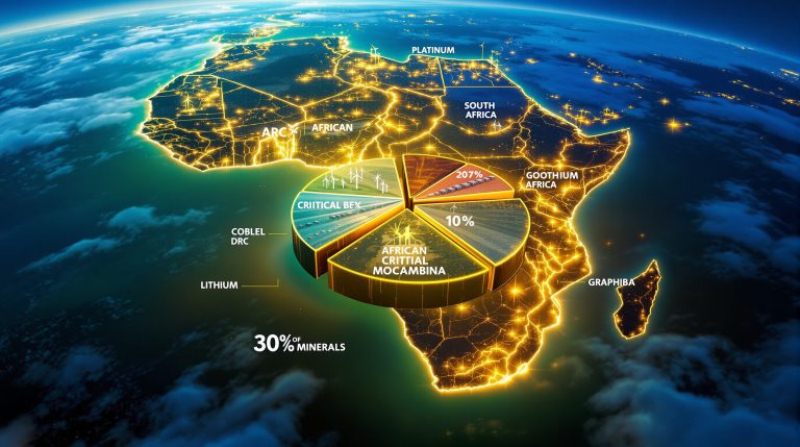
Holding approximately 30 per cent of the world’s critical mineral reserves – including the largest global shares of platinum group metals (PGMs), manganese and chrome – Africa is well positioned to play a leading role in global supply chains. However, with intra-African trade accounting for only 16 per cent of total African trade, significant opportunities remain to strengthen cross-border cooperation and build integrated mineral value chains
By The Weekly Vision Reporter
As Africa seeks to capitalise on surging global demand for critical minerals to drive GDP growth and industrialisation, regional collaboration is emerging as a strategic imperative to unlock the continent’s full resource potential.
Holding approximately 30 per cent of the world’s critical mineral reserves – including the largest global shares of platinum group metals (PGMs), manganese and chrome – Africa is well positioned to play a leading role in global supply chains. However, with intra-African trade accounting for only 16 per cent of total African trade, significant opportunities remain to strengthen cross-border cooperation and build integrated mineral value chains.
Enhanced regional collaboration offers a pathway for African countries to address long-standing structural challenges, including limited access to finance, inadequate infrastructure and shortages of technical skills.
Against this backdrop, African governments and mining financiers are accelerating partnerships to enhance geological knowledge, unlock investment and strengthen industrial capacity. A notable example is a cooperation agreement between the Ministry of Mines and Geological Resources of Gabon and the Council for Geoscience of South Africa.
The partnership enables Gabon to leverage the technical expertise of South Africa in geological mapping, exploration and resource assessment to improve its national mineral database and support the diversification of its mining sector. With South Africa’s extensive experience as the world’s leading producer of PGMs, chrome and manganese, as well as its historical position as a dominant gold producer, the agreement provides Gabon with technical support to accelerate the development of its potash, manganese and iron ore sectors.
Equally important, the partnership prioritises local capacity building, workforce development and knowledge transfer, strengthening Gabon’s institutional and technical capabilities to support long-term growth in the mining sector.
“Africa’s integration is a strategic economic vision. Harmonising natural resource laws and aligning with frameworks such as the ECOWAS Mining Code and the African Minerals Vision is key, but national interests disrupt continental coordination, limiting the continent’s mining potential,” said Emmanuel Armah-Kofi Buah, Ghana’s Minister of Lands and Natural Resources, in Cape Town earlier this month.
Financial cooperation is also playing a pivotal role in unlocking regional mineral development. In February 2026, the Industrial Development Corporation signed a memorandum of understanding with the Fonds de Promotion de l’Industrie of the Democratic Republic of Congo to jointly finance and co-develop projects across the mining, energy and logistics value chain.
The agreement brings together two of Africa’s most strategically important mineral economies, combining South Africa’s financial capacity and industrial expertise with the DRC’s vast reserves of cobalt, copper, tin and other critical minerals. By aligning development finance institutions, the partnership is expected to ease funding constraints that have historically delayed project development, while directing capital towards beneficiation infrastructure, processing facilities and transport corridors that enable greater value addition within Africa.
Similarly, several African producers are leveraging South Africa’s technical expertise to de-risk exploration and accelerate mineral sector development. Nigeria and South Sudan have signed cooperation agreements with South African institutions focused on geological mapping, exploration and technical collaboration.
These partnerships form part of broader national strategies to diversify economic growth away from petroleum dependence and towards mining-led industrialisation. By strengthening geological knowledge and improving resource certainty, such agreements enhance investor confidence, reduce exploration risk and position Nigeria and South Sudan to attract long-term mining investment.
The agreements reflect a growing recognition among African governments that regional cooperation is essential to unlocking the continent’s mineral wealth. Many of Africa’s most valuable mineral belts extend across national borders, making coordinated infrastructure development, regulatory alignment and investment frameworks critical for efficient resource extraction and commercialisation.
Regional cooperation enables countries to pool financial resources, share infrastructure such as railways, power systems and ports, and coordinate industrial strategies that support downstream beneficiation and manufacturing.
Speaking in Cape Town in mid-February, Henry Alake, Nigeria’s Minister of Solid Minerals Development, said: “Africa must finance strategic mineral corridors such as Lagos–Abidjan and Lagos–Maputo, not just to export raw materials, but to build cross-border processing industries that create jobs and retain value within the continent.”
Building on the growing momentum for regional cooperation, African Mining Week, scheduled to take place from 14 to 16 October in Cape Town, is expected to serve as a critical platform for advancing partnerships across the continent’s mining sector. The event will bring together policymakers, investors, mining companies and financial institutions to strengthen collaboration, showcase investment opportunities and accelerate the development of integrated African mineral value chains.
As Africa positions itself at the centre of the global energy transition and the critical minerals supply chain, such partnerships will be instrumental in transforming the continent’s resource wealth into long-term economic growth and industrial development.