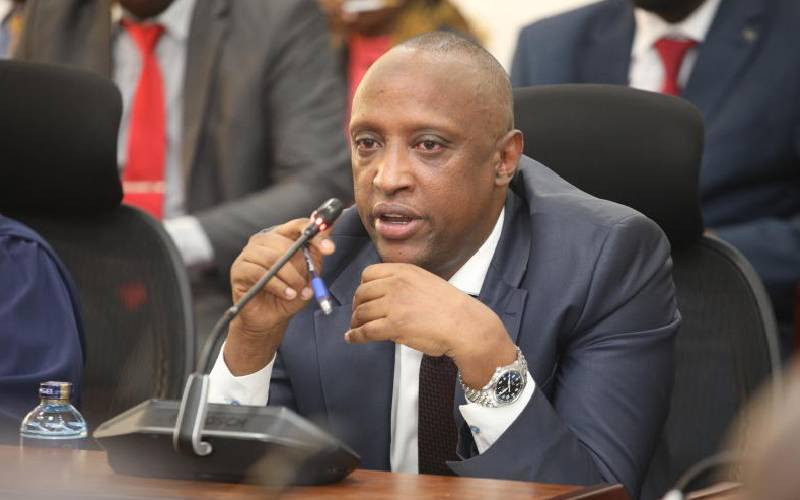
The situation has been further complicated by recent remarks by Agriculture Cabinet Secretary Mutahi Kagwe (above), who acknowledged to farmers that Kenya does not currently produce enough sugar to meet domestic demand and will therefore continue to rely on imports.
[Photo: Courtesy]
Sugarcane farmers have rejected the proposed 2026/27 strategic plan for the sugar industry, insisting that reforms cannot proceed before the establishment of a legally constituted Kenya Sugar Board (KSB), as required under the Sugar Act, 2024.They argue that sector managers are attempting to advance policy and institutional reforms without first putting in place the governance structures mandated by law. They say the immediate priority should be the fast-tracking of elections to form a substantive KSB board
Premium
To unlock the full article: Choose one of the options below:
Ksh 10 – This article only
Ksh 50 – Access to ALL articles on the site (full site access)
Ksh 300 – Monthly subscription
Ksh 2340 – Yearly subscription (10% off)
By The Weekly Vision Reporter
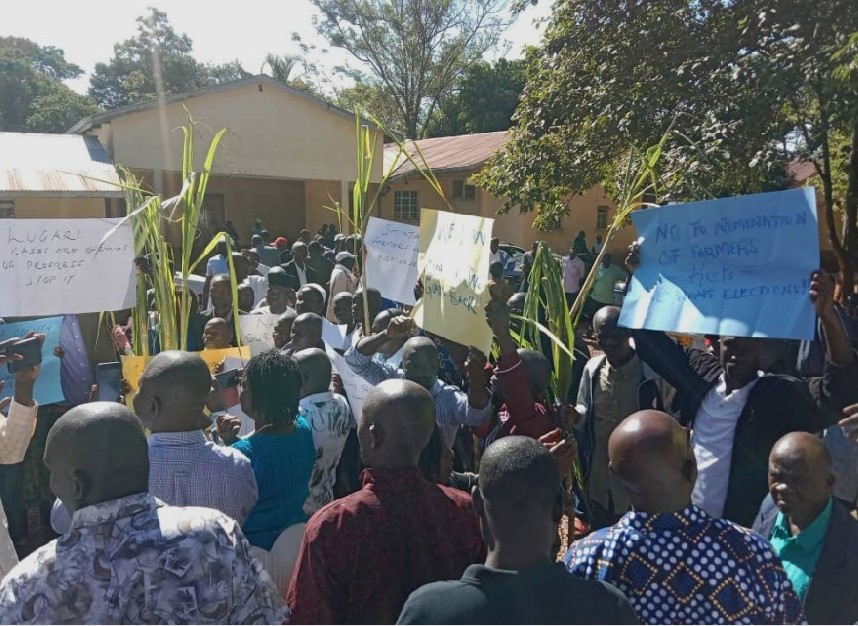
Sugarcane farmers have rejected the proposed 2026/27 strategic plan for the sugar industry, insisting that reforms cannot proceed until a legally constituted Kenya Sugar Board (KSB) is established, as required under the Sugar Act, 2024.
The farmers argue that sector managers are attempting to advance policy and institutional reforms without first establishing the governance structures mandated by law. They say the immediate priority should be the fast-tracking of elections to form a substantive KSB board.
Sugarcane farmers. [Photo: Courtesy]
Speaking through the Kenya National Sugarcane Federation (KNSF), officials Ezra Okoth and Killion Osur said farmers will not endorse or support any strategic plan developed under interim arrangements. According to the federation, a legally constituted board is the only credible mechanism to safeguard growers at a time when the local sugar industry is facing mounting pressure from regional competition.
The farmers’ position comes in the wake of Kenya’s exit from COMESA safeguard measures that, for more than three decades, protected the local sugar sector from imports from member states. With the safeguards lifted, Kenya’s market is now fully open to sugar from the regional bloc, much of which is produced at lower cost and, in some countries, supported through state subsidies.
“The first thing that must be done is KSB elections,” said KNSF Secretary-General Killion Osur, stressing that farmers must be represented at the highest decision-making level if they are to be protected from the adverse effects of liberalised imports. Ezra Okoth warned that, without a substantive board, growers remain exposed to unfair competition and weak regulatory oversight.
The situation has been further complicated by recent remarks by Agriculture Cabinet Secretary Mutahi Kagwe, who acknowledged to farmers that Kenya currently does not produce enough sugar to meet domestic demand and will therefore continue to rely on imports. While the statement reflects the country’s supply realities, farmers say it underscores the urgency of establishing a fully constituted KSB to regulate imports, protect local producers and enforce fair trade practices. Industry analysts note that the absence of a substantive board at a time when the market has been liberalised could leave farmers vulnerable to price suppression, delayed payments and manipulation by millers, problems that have historically destabilised the sector.
However, the farmers insist that their position should not be interpreted as opposition to reform. Rather, they say the dispute is about sequencing. “We welcome the idea of a strategic plan, but governance comes first,” Osur said. “The Sugar Act, 2024, is clear.
The board must be established in accordance with the law before any long-term roadmap is adopted.”The federation argues that without farmer representation on the board, strategic plans risk becoming technocratic documents detached from realities on the ground, including rising production costs, persistent delays in cane payments and declining farm-gate prices.
The rejection of the proposed strategy also reflects deeper mistrust within the industry, where previous reform initiatives have often faltered due to weak oversight and limited stakeholder involvement. Farmers say experience has shown that policy commitments offer little protection in the absence of strong institutions capable of enforcing them.
The farmers were speaking during a Kenya Sugar Board stakeholders’ meeting held at Kisumu Sunset Hotel. KSB chairperson Nicholas Gumbo and Chief Executive Officer Jude Chesire, who attended the meeting, acknowledged the farmers’ concerns. Chesire confirmed that the board had agreed to suspend the strategic planning process to allow for further consultations with stakeholders. “We have heard the farmers and accepted their position,” he said, adding that the exercise would be put on hold as engagement continues.
Nevertheless, farmers view the suspension as a temporary concession rather than a resolution. Their demand remains firm: elections to establish a substantive Kenya Sugar Board must be held before any strategic planning resumes. With Kenya now operating in a fully liberalised regional sugar market, farmers argue that a properly constituted KSB is no longer merely a governance requirement, but a strategic necessity to manage imports, enforce standards and stabilise the industry.
As pressure mounts from both domestic supply shortages and intensifying regional competition, the sugar sector finds itself at a critical crossroads. Whether policymakers choose to anchor reforms in law and representation, farmers say, may ultimately determine whether the industry adapts to liberalisation or collapses under its weight.