By The Weekly Vision Reporter
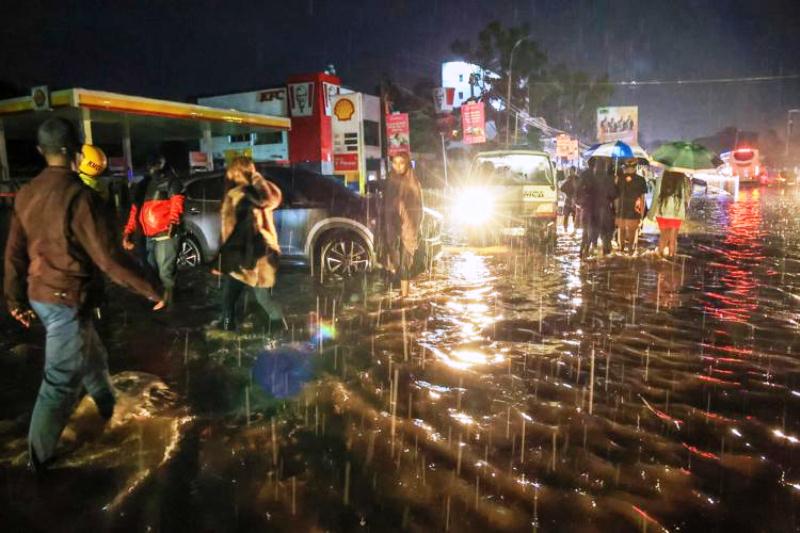
Heavy flooding in Nairobi last Friday, following a massive downpour, has once again highlighted the urgent need to overhaul the city’s drainage and waste management systems. The floods disrupted transport, damaged property, and exposed long-standing weaknesses in the capital’s urban planning and drainage infrastructure.
Nairobi Governor Johnson Sakaja has said fixing the city’s drainage system would require about KSh 25 billion, a sum he argues the county government cannot raise without severely affecting other critical operations, including the payment of staff salaries. Speaking during an interview on a local television station on Sunday, Sakaja said the county government is seeking a transaction adviser to help identify potential financiers for the project.
However, he noted that legal restrictions, particularly under the Public Finance Management Act, could complicate efforts to secure external financing. Even as the county government explores possible funding options, the national government has also pledged support to address Nairobi’s recurring flooding problem. Last month, President William Ruto announced that the national government would invest about KSh 30 billion in drainage and sewer infrastructure in the capital.
Speaking during an event at State House, Nairobi, on 17 February, the President said the government would allocate KSh 1 billion immediately for drainage improvements. “We all know what happens to Nairobi City when it rains, and my instructions to the relevant ministries are that we do not want a flooded city this year,” he said, directing the Ministry of Roads and the Ministry of Housing to fast-track interventions.
The broader infrastructure plan also includes KSh 3 billion for last-mile sewer connectivity, KSh 15 billion for long-term sewer expansion across the city, and KSh 9 billion for the construction of two parallel 27-kilometre trunk sewer networks along the Nairobi River corridor.
In addition, KSh 6 billion has been earmarked for a new sewer treatment plant expected to process about 60,000 cubic metres of wastewater per day. However, critics argue that Nairobi’s flooding crisis cannot be solved through drainage infrastructure alone.
Activist Boniface Mwangi says the problem is rooted in years of poor governance, including the approval of buildings on riparian land, blocked stormwater drains, and the dumping of solid waste into drainage channels and rivers.
Mwangi called for action against what he described as “garbage cartels”, individuals or groups allegedly paid to collect waste but who instead dump it along roadsides or into rivers. “It’s important to note that despite repeated budget allocations over the years, the government is always caught flat-footed,” Mwangi says.
“Disaster management is not only about responding after tragedy strikes but preventing it from happening. When homes built on riparian land are demolished, the law must apply equally, not only in low-income areas such as Mukuru, Kibera and Mathare, but also in affluent neighbourhoods like Kilimani, South C and Lang’ata.” He added that authorities must prioritise clearing blocked waterways before the rainy season, maintaining road infrastructure and protecting green spaces instead of allowing uncontrolled construction.
Lawyer and governance commentator Steve Biko Wafula also criticised the county government’s handling of the situation, describing Nairobi’s flooding as a failure of governance rather than a natural disaster. “Floods in Nairobi are not acts of God. They are acts of governance failure,” he said. “Drainage blocked by garbage, construction allowed on waterways, urban planning ignored, and enforcement weak or nonexistent, these are not natural disasters. They are policy failures.”
Wafula argued that the city’s recurring floods reflect a deeper leadership problem, noting that residents are increasingly frustrated by what they see as repeated promises without meaningful action. “A governor must understand that public anger is not disrespect. It is accountability,” he said. “Nairobi residents are tired of watching a once-proud city slide into chaos while politicians trade blame and chase headlines. If Nairobi is to recover, the culture of excuses must end.”
He urged citizens to demand greater transparency regarding budgets, infrastructure timelines and concrete plans to address flood control and waste management.
As Nairobi continues to expand rapidly, experts warn that without stronger enforcement of urban planning laws, improved waste management and sustained investment in drainage infrastructure, the city will remain vulnerable to flooding during heavy rains.