By The Weekly Vision International News Desk
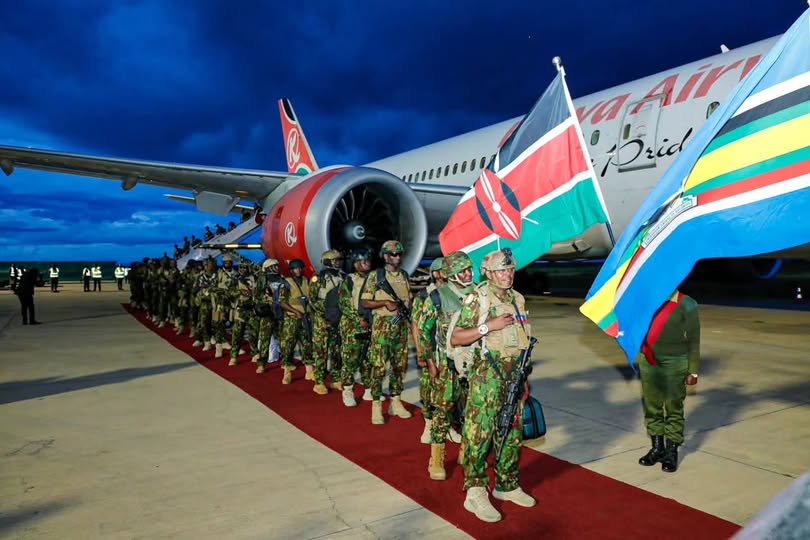
Kenya’s high-profile security deployment to Haiti has formally come to an end, with the final contingent of police officers having departed for Nairobi on 27 April 2026. The withdrawal from Haiti marks the conclusion of Kenya’s leadership role in the United Nations-backed Multinational Security Support (MSS) mission, an intervention that has increasingly come under scrutiny at home.
From the outset, the government framed the mission as a stabilisation effort aimed at reclaiming gang-controlled areas, securing critical infrastructure and supporting the Haitian National Police. However, months into the deployment, questions began to emerge about the mission’s effectiveness, transparency, and the broader motivations behind Nairobi’s involvement.
Credible international reports indicate that armed gangs continue to exert control over large parts of Port-au-Prince and the countryside, with violence, kidnappings and general lawlessness still widespread. Although Kenyan officers conducted joint patrols and secured limited installations, analysts suggest these gains were incremental and fragile rather than transformative.
Security experts now argue that the mission may have been overly ambitious from the beginning, given Haiti’s entrenched political instability and weak state institutions. Despite these concerns, officials in Nairobi consistently defended the deployment, albeit with limited operational detail.
Interior Cabinet Secretary Kipchumba Murkomen maintained that Kenyan police were well-trained for complex international assignments and that the mission was a success, though he offered little in the way of detailed progress reports. Prime Cabinet Secretary Musalia Mudavadi, who also oversees the foreign affairs docket, framed the mission as a demonstration of Kenya’s commitment to global peacekeeping and an opportunity to enhance its diplomatic standing.
At the administrative level, Interior Principal Secretary Raymond Omollo echoed this stance, pointing to coordination with international partners while providing minimal public disclosure on operational outcomes. Meanwhile, police leadership under Inspector General Douglas Kanja adopted a cautious tone, emphasising officer welfare and professionalism without explicitly characterising the mission as either a success or a failure. The deployment, however, came at a human cost.
The deaths of Kenyan police officers, Samuel Kaetuai, Benedict Kabiru and Corporal Kennedy Mutuku Nzuve, served as a stark reminder of the risks involved. Their loss triggered public concern over preparedness, contingency planning and the level of transparency surrounding the mission. For many Kenyans, the fatalities sharpened a broader debate about whether the country was adequately equipped, both logistically and strategically, to lead such a complex international operation.
Critics argue that Kenya’s role may have been influenced as much by the pursuit of global prestige as by genuine security imperatives. By stepping into a leadership vacuum, Nairobi positioned itself as a significant player on the international stage. Yet analysts caution that diplomatic ambition must be weighed against measurable outcomes, particularly where national resources and personnel are at stake. Calls from Parliament and civil society for greater accountability and detailed reporting have grown louder in recent months. In retrospect, the Haiti mission appears to have delivered limited stabilisation in select areas but fell short of the decisive breakthroughs initially envisaged.
Experts warn that without sustained international backing, clearly defined benchmarks and stronger transparency mechanisms, the operation risked becoming a prolonged engagement with diminishing returns from the outset. For Kenya, the implications are both practical and reputational.
A successful mission could have cemented its status as a regional leader in peacekeeping. Instead, the outcome risks reinforcing perceptions of strategic overreach. As the dust settles, a critical question remains unresolved: was Kenya’s intervention in Haiti a necessary contribution to global security, or a costly gamble shaped by ambition and international expectation?
[/full]