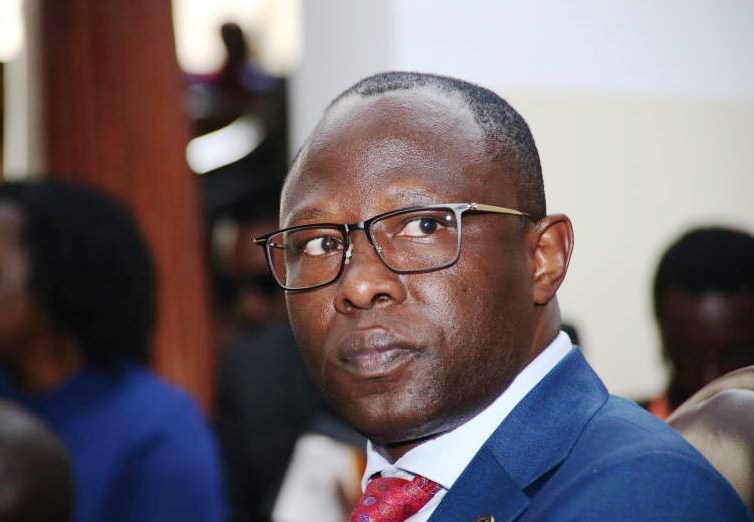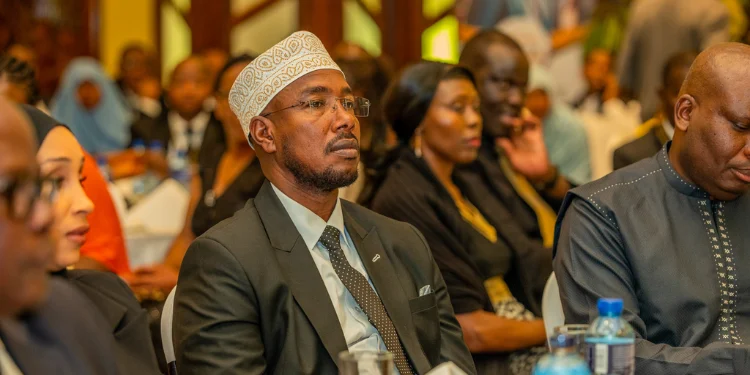
Marjan’s exit under a cloud joins a troubling pattern for IEBC chiefs, following predecessors Chiloba and Oswago whose tenures ended amid controversy and abrupt dismissal
To unlock the full article:
Choose one of the options below:
- Ksh 10 – This article only
- Ksh 50 – Access to ALL articles on the site (full site access)
- Ksh 300 – Monthly subscription
- Ksh 2340 – Yearly subscription (10% off)
By The Weekly Vision Political Desk
The sudden exit of Independent Electoral and Boundaries Commission (IEBC) Chief Executive Officer and Commission Secretary Marjan Hussein Marjan has reopened uncomfortable questions about the stability, independence and integrity of Kenya’s electoral management body.
Marjan left office on Tuesday, 3 February, barely months before the next General Election, in a departure the Commission described as a “mutual and structured transition”. His contract was due to run until March next year. Behind the carefully worded statement, however, a more troubling picture is emerging.
With his exit, Marjan becomes the third substantive head of the IEBC secretariat to leave office since the transition from the former Interim Independent Electoral Commission (IIEC) to the current IEBC, after James Oswago and Ezra Chiloba. None of the three completed a smooth, controversy-free tenure.
The pattern has renewed public anxiety over whether the office of the IEBC Chief Executive, arguably the most powerful administrative position in the electoral system, has become politically exposed and institutionally fragile.
Marjan has since been replaced by the IEBC Director of Electoral Operations, Moses Ledama Sunkuli, in an acting capacity for six months or until a substantive Chief Executive Officer is appointed, according to Chairperson Erastus Ethekon.
Announcing the appointment on Thursday, Ethekon said Sunkuli brings extensive experience and strong institutional knowledge to the role. The former geography teacher joined the Commission in 2009 and is regarded as having a deep understanding of its operations.
However, his appointment is likely to attract intense scrutiny from the opposition and other stakeholders. Sunkuli was previously in the spotlight following the chaos at the Bomas of Kenya National Tallying Centre during the 2022 General Election, when he was alleged to have been part of a team that manipulated results in favour of UDA candidate William Ruto.
At the height of the standoff, he reportedly left his electronic devices on a table and disappeared, with then IEBC chairperson Wafula Chebukati (now deceased) informing the nation that a staff member had gone missing.
“We have walked the journey of ensuring Kenyans get free, fair and credible elections. It has not been an easy journey. Right now, two of my commissioners and the CEO are injured. We have staff who have been profiled. There is a staff member who disappeared while on duty. We also have staff who have been arbitrarily arrested for no reason, and I do not know where they are at the moment,” Chebukati said at the time. Sunkuli later re-emerged after William Ruto had been declared the winner.
In announcing Marjan’s exit, the Commission said the decision was intended to ensure a “seamless transition” and continuity in the delivery of its constitutional mandate, including elections and boundary delimitation.
Critics, however, argue that changes within the IEBC secretariat, the engine room of election management, cannot be treated as routine administrative matters, particularly so close to a national poll.
The secretariat is responsible for planning and executing all electoral activities, continuous voter registration and revision of the voters’ roll, election technology, including the Biometric Voter Registration (BVR) system and the Kenya Integrated Election Management System (KIEMS), as well as logistics, procurement, training, voter education and stakeholder engagement.
It is this nerve centre that has repeatedly come under scrutiny whenever Kenya’s elections are disputed. Marjan’s departure came only days after leaders of the United Opposition visited the IEBC headquarters at Anniversary Towers and issued a series of ultimatums.
Opposition leaders, including Kalonzo Musyoka, Martha Karua, Rigathi Gachagua, Fred Matiang’i and Eugene Wamalwa, publicly declared that they had lost confidence in Marjan’s leadership and demanded his removal.
At the centre of their protest was the Commission’s continued engagement with Smartmatic, the technology firm that supplied the KIEMS kits used in the 2022 General Election. The opposition accused the company of being linked to electoral controversies in other jurisdictions and demanded that the IEBC disengage from it and overhaul its election technology systems.
More significantly, Marjan is alleged to have authorised an extension of a KIEMS-related contract in 2024 without full approval of the Commission, at a time when the IEBC itself was not fully constituted.
‘We expect transparency, accountability and decisive action if public trust in the electoral process is to be restored,’ Wiper Party leader Kalonzo Musyoka said.
Eugene Wamalwa was more direct. “We are also demanding that Marjan must go. He broke and violated the law by granting an illegal extension to Smartmatic and abused his office,” he said, warning that street demonstrations would follow if the demand was ignored.
The IEBC has not publicly clarified when the extension was approved, nor the procurement process that was followed. What remains unresolved is whether the contract extension and the political pressure surrounding it triggered the internal fallout that culminated in Marjan’s exit.
Smartmatic itself has faced sustained international scrutiny. The company has previously been linked to disputed elections in several countries.
In the United States, the firm became embroiled in political controversy following claims by former President Donald Trump that the 2020 presidential election had been manipulated in favour of Joe Biden, allegations that were widely contested in court.
In 2024, the company suffered a further reputational setback when the United States Department of Justice charged three current and former Smartmatic executives over an alleged scheme involving more than US$1 million in bribes linked to the securing of voting-machine contracts in the Philippines.
Separately, federal prosecutors in South Florida alleged that Smartmatic co-founder Roger Piñate secretly bribed Venezuela’s former elections chief, Tibisay Lucena Ramírez, by transferring control of a luxury property in Caracas in exchange for political favours.
According to prosecutors, the alleged payments were intended to secure assistance in a commercial dispute between Smartmatic and the Venezuelan government following the company’s public accusation in 2017 that the Nicolás Maduro administration had manipulated results in a constitutional assembly election.
It is against this backdrop that Kenyan opposition leaders insist that continued reliance on Smartmatic places the credibility of the next election at risk.
Marjan joined the IEBC in 2015 as a Deputy Commission Secretary before rising to the position of Chief Executive Officer. His departure now places him alongside two predecessors whose tenures ended under clouds of controversy.
Ezra Chiloba, who became CEO in January 2015, was dismissed three years later after the late IEBC chairperson Wafula Chebukati said the Commission had found him culpable following an internal audit.
“Mr Chiloba’s gross misconduct, breach and violations of the Commission’s human resource and administration policies left the Commission with no option other than to terminate his employment,” Chebukati said at the time.
Chiloba later became a principal partner at Chil & Kemp Strategies and was appointed Director-General of the Communications Authority of Kenya in 2021, before resigning after being suspended over allegations of misuse of office. In 2024, he was appointed Kenya’s Consul-General in Los Angeles.
James Oswago, who served as IEBC Chief Executive from about 2009 until his term ended in 2013, was later convicted over the irregular award of a KSh1.3 billion tender for voter materials during the 2013 General Election.
In 2024, Justice Nixon Sifuna upheld the conviction of Oswago and former Deputy Commission Secretary Wilson Kiprotich Shollei, ruling that the prosecution had proved its case. Each was fined KSh7.5 million or, in default, sentenced to four years’ imprisonment.
The repeated legal and administrative scandals linked to the office have reinforced fears that the position has become both politically pressured and structurally vulnerable.
Kenya National Civil Society Centre Executive Director Suba Churchill said the revolving door at the top of the IEBC secretariat reflects deeper institutional weaknesses.
Ideally, he said, office holders should be allowed to serve their full terms. “We know that Hussein Marjan still had one year to complete his first term. The problem is not only the law, but the way individuals are recruited into these offices and whether they are able to deliver on public expectations,” Churchill said.
Political analyst Professor Herman Manyora argued that the relationship between commissioners and the secretariat has weakened the office of the Chief Executive.
Under normal circumstances, he said, the Commission Secretary should run the day-to-day operations of the Commission, while commissioners exercise oversight and set policy. Instead, Kenya has developed a system in which commissioners are perceived to be running the secretariat itself, a structure that inevitably fuels internal conflict.
Homa Bay MP Peter Kaluma took a different view, arguing that the departure of one individual should not paralyse the institution. He said the immediate priority should be cleaning the voters’ register by removing multiple registrations and the names of deceased voters.
Beyond procurement concerns, fresh controversy has emerged over a meeting between IEBC commissioners and Head of Public Service and Chief of Staff Felix Koskei, held only hours before Marjan’s exit was announced.
Opposition leaders claimed the commissioners were summoned by Koskei shortly after their own meeting with the Commission. Wamalwa questioned whether the meeting was linked to the choice of Marjan’s replacement and warned against political interference in an independent commission.
Human rights activist Ndung’u Wainaina said the Constitution clearly insulates independent commissions from executive direction.
“Independent commissions and offices are not subject to orders of the Presidency. The word ‘independent’ is not semantic,” he said.
Koskei defended the engagement, stating that the public service has a responsibility to support constitutional commissions while respecting their independence. He said the discussions formed part of ongoing coordination between the Executive and independent offices within clearly defined constitutional boundaries.
The fully constituted IEBC, appointed in July 2025 and chaired by Erastus Ethekon, is under intense pressure to rebuild public trust after years of controversy, including the annulment of the 2017 presidential election by the Supreme Court and persistent disputes over the credibility of the 2022 results.
In its statement announcing Marjan’s exit, the Commission said it would embark on internal reforms aimed at strengthening accountability and institutional preparedness.
“We wish to assure Kenyans that any changes will be designed to ensure effective institutional preparedness, strengthen internal accountability and sustain leadership continuity,” the Commission said.
Yet, for many observers, the central question remains unanswered: was Marjan’s exit driven by administrative considerations, or by the political fallout surrounding the alleged extension of the Smartmatic contract and mounting opposition pressure?
As the IEBC prepares to recruit its next Chief Executive Officer, the process is expected to attract unprecedented public and political scrutiny.
Equally unresolved is whether the Commission will disengage from Smartmatic or fundamentally overhaul its election technology systems, as demanded by the opposition.
Former Azimio chief agent Saitabao ole Kanchory has warned that removing one official may not dismantle what he described as deeply embedded structures within the electoral body, arguing that the real challenge lies in the wider institutional culture of the Commission.
For now, Marjan’s departure has deepened, rather than resolved, doubts about the independence of the IEBC secretariat and whether Kenya is ready to enter the next election cycle without carrying the baggage of its troubled past.
[/full]